
INTRODUCTION
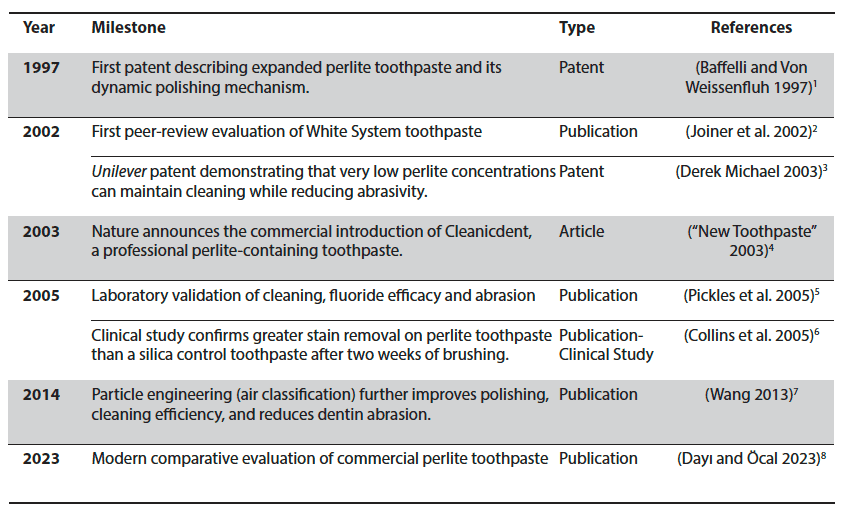
Expanded perlite is a naturally occurring amorphous volcanic glass that has attracted considerable interest as a functional abrasive for whitening toothpastes. And this is because, unlike conventional abrasives, expanded perlite combines efficient stain removal with a unique polishing mechanism arising from its platelet-like morphology and progressive particle-size reduction during brushing. These characteristics have led to nearly three decades of industrial development, beginning with the first patents in the late 1990s and continuing through commercial products, clinical trials and recent particle-engineering studies, presented in Table 1.
Commercial Adoption of Perlite Toothpaste
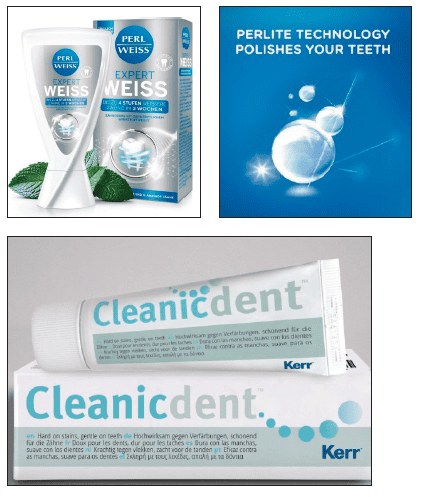
The commercial potential of expanded perlite in oral care products was recognized in the early 2000s. In 2003, Nature highlighted the introduction of Cleanicdent, a professional toothpaste formulated with expanded perlite for use in dental practices (“New Toothpaste” 2003). The product was reported to provide effective stain removal while minimizing damage to tooth enamel and soft oral tissues.
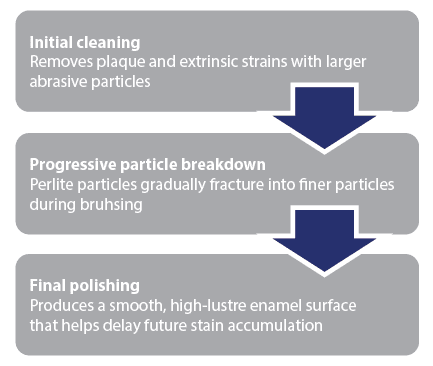
The superior performance of expanded perlite was attributed to its unique particle behaviour during brushing, which provides a dynamic two-stage cleaning and polishing mechanism (Figure 1).
Because of these advantages, Cleanicdent was marketed exclusively through dental practices, demonstrating the confidence of the dental community in perlite-based polishing technology and representing one of the earliest commercial applications of expanded perlite in professional oral care.
Patents
Patents have played an important role in the development of perlite-containing dentifrices, demonstrating both the technical feasibility and the performance advantages of expanded perlite in oral care formulations. The following patents represent two key milestones, describing the evolution from conventional perlite-based abrasives to optimized low-dose formulations with improved cleaning-to-abrasion performance.
• Expanded perlite toothpaste (Baffelli et al., US 5597553, 1997) (Baffelli and Von Weissenfluh 1997)
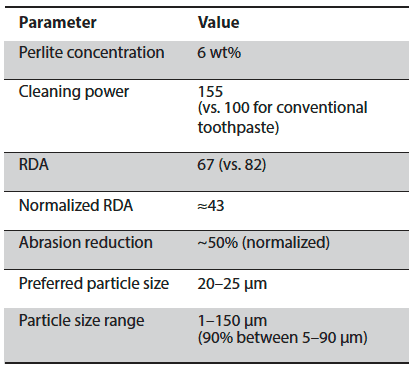
The first patent describing the use of expanded perlite as the primary abrasive in a toothpaste represented a major milestone in the development of perlite-based oral care products. Building upon the dynamic polishing concept described previously, the inventors demonstrated that expanded perlite could provide substantially greater cleaning efficiency while reducing abrasion of hard dental tissues compared with conventional abrasive systems.
The patented formulation contained 6 wt% expanded perlite and exhibited a cleaning power approximately 55% higher than that of a conventional commercial toothpaste, while reducing the normalized Relative Dentin Abrasion (RDA) by almost 50%. The patent further identified an optimum abrasive fraction with a dominant particle size of 20–25 μm, providing an effective balance between stain removal and polishing. Representative performance data reported in the original patent are summarized in Table 2.
• Oral composition containing perlite (Unilever, EP 1183006B1, 2003) (Derek Michael 2003)
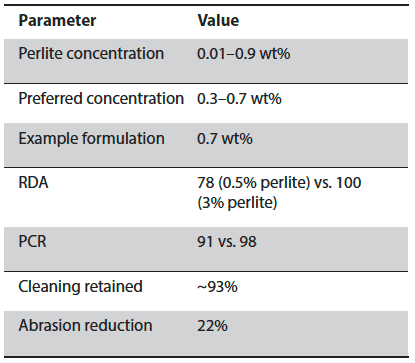
A second important development in perlite-containing dentifrices was reported by Unilever in 2003, demonstrating that expanded perlite can function as a performance-enhancing additive rather than as the primary abrasive. The patent showed that very small additions of perlite (0.01–0.9 wt%, preferably 0.3–0.7 wt%) were sufficient to retain most of the cleaning benefit while substantially reducing abrasivity. This represented a significant shift in formulation strategy, enabling manufacturers to exploit the polishing properties of perlite without the disadvantages associated with higher concentrations.
Besides lowering tooth abrasion, the reduced perlite content minimized formulation problems commonly associated with larger additions, including flavour degradation, grey speckling caused by natural mineral impurities, and instability (syneresis) of the toothpaste. Representative formulation characteristics and performance data are summarized in Table 3.
Scientific validation of Perlite-Based Toothpaste
Laboratory Validation
Before large-scale clinical studies became available, laboratory investigations had already demonstrated that expanded perlite was an effective and safe abrasive for whitening toothpastes. The first comprehensive evaluation was reported by Joiner et al. (2002) using the commercial White System toothpaste (Joiner et al. 2002). The authors described expanded perlite as a chemically inert volcanic glass that, after expansion and milling, forms flat platelet-like particles capable of efficiently removing extrinsic stains while minimizing enamel scratching through their tendency to align parallel to the tooth surface during brushing.
Using the Stookey laboratory cleaning method1, the perlite-containing toothpaste achieved significantly greater stain removal than a conventional silica toothpaste, reaching 63.8% vs. 40.1% after 400 brushing cycles and 70.3% vs.47.6% after 600 cycles (p < 0.001). Importantly, these improvements were obtained without a statistically significant increase in enamel wear, while the reported Relative Dentin Abrasion (RDA ≈ 100) remained well below the ISO limit of 250.
The laboratory evidence was further strengthened by Pickles et al. (2005), who evaluated a whitening toothpaste combining calcium carbonate and expanded perlite (Pickles et al. 2005). The formulation outperformed three commercially available whitening toothpastes in Pellicle Cleaning Ratio (PCR) tests, achieving 80.2% stain removal after 800 brushing cycles. At the same time, enamel wear (0.08 μm) and dentine wear were comparable to those of commercial whitening formulations, while fluoride efficacy was maintained, demonstrating that the incorporation of perlite did not compromise remineralization performance.
Overall, these laboratory studies established that expanded perlite provides an excellent balance between stain-removal efficiency, polishing ability and low abrasivity, thereby providing the scientific foundation for the subsequent clinical validation of perlite-containing whitening toothpastes. 1
Clinical Validation
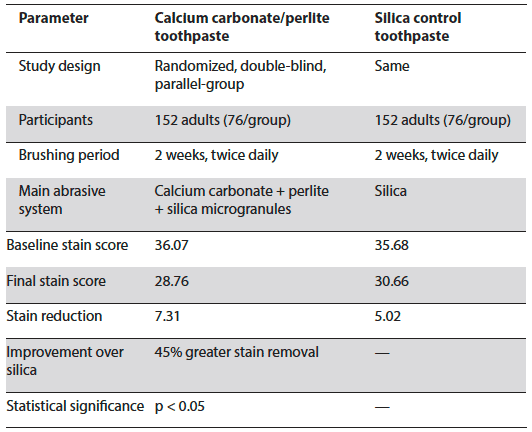
The stain-removal performance of perlite-containing toothpaste has been clinically validated in a randomized, double-blind, parallel-group study involving 152 adult participants (Collins et al. 2005). Subjects brushed twice daily for two weeks using either a whitening toothpaste formulated with a calcium carbonate/perlite/silica microgranule abrasive system or a conventional silica-based control toothpaste. Perlite was described as a chemically inert, amorphous volcanic aluminosilicate that expands upon rapid heating to form a characteristic porous, platelet-like structure, making it a highly effective polishing and cleaning agent.
Both toothpastes significantly reduced naturally occurring extrinsic tooth stain compared with baseline (p < 0.001). However, the calcium carbonate/perlite formulation demonstrated superior whitening performance, reducing the mean stain score by 7.31 units, compared with 5.02 units for the silica control. Overall, the perlite-containing toothpaste achieved 45% greater stain removal after only two weeks of regular brushing, with the difference between the two formulations being statistically significant (p < 0.05). These findings provide strong independent clinical evidence that perlite-based abrasive systems enhance stain removal and improve whitening performance under normal oral hygiene conditions.
- https://doi.org/10.1177/00220345820610110501 ↩︎
Recent Developments
Recent research has demonstrated that the performance of expanded perlite can be further enhanced through optimization of its particle size and morphology. Wang et al. reported that air classification of commercial expanded perlite effectively removed coarse particles, producing abrasive fractions enriched in fine, platy particles that are particularly suitable for oral care applications (Wang 2013). When incorporated into a whitening toothpaste, the optimized perlite provided slightly improved cleaning performance, significantly better tooth polishing, and lower dentin abrasion than a widely used high-cleaning silica abrasive. These improvements were attributed to the combination of an optimized particle size distribution and the unique platelet-like morphology of expanded perlite, highlighting the importance of particle engineering in maximizing cleaning efficiency while minimizing tooth abrasion.
The continued relevance of perlite as a whitening abrasive is further demonstrated by more recent studies comparing commercial perlite-containing toothpastes with newer whitening technologies. In a comparative study by Dayı and Öcal (2023), Signal White System, a commercial toothpaste containing expanded perlite, was evaluated alongside toothpastes containing nanohydroxyapatite and hydrogen peroxide (Dayı and Öcal 2023). Although nanohydroxyapatite- and peroxide-based formulations produced greater whitening during the early stages of brushing, the perlite-containing toothpaste exhibited the greatest color improvement after 30 days of simulated brushing. Moreover, no significant increase in surface roughness was observed for supra-nano-filled composite restorations following brushing with the perlite toothpaste, confirming that effective long-term whitening can be achieved without compromising restorative surface integrity.
Together, these studies demonstrate that research on perlite abrasives has evolved from validating their cleaning performance to optimizing their physical characteristics and benchmarking commercial formulations against emerging whitening technologies. Nearly three decades after their commercial introduction, perlite-containing toothpastes remain competitive, scientifically supported, and continue to represent an attractive abrasive technology for modern oral-care formulations.
Concluding Remarks
Over the past three decades, expanded perlite has evolved from a novel abrasive into a scientifically validated ingredient for whitening toothpastes. Patents, laboratory investigations, clinical studies and commercial products consistently demonstrate that perlite combines effective stain removal with excellent polishing performance while maintaining low abrasivity. Continued advances in particle engineering have further improved its performance, and recent comparative studies confirm that commercial perlite-containing toothpastes remain competitive with modern whitening technologies. Future developments are expected to focus on optimized particle design and multifunctional formulations, further strengthening the role of expanded perlite in next-generation oral care products.
Bibliography
[1] Baffelli, Gianni, and Beat A Von Weissenfluh. 1997. Expanded perlite toothpaste, issued 1997.
[2] Joiner, A., M. J. Pickles, J. R. Matheson, E. Weader, L. Noblet, and E. Huntington. 2002. “Whitening Toothpastes: Effects on Tooth Stain and Enamel.” International Dental Journal 52 (5 SUPPL.2): 424–30. https://doi.org/10.1111/j.1875-595x.2002.tb00732.x.
[3] Derek Michael, C. 2003. “ORAL COMPOSITION CONTAINING PERLITE – UNILEVER N.”
[4] “New Toothpaste.” 2003. British Dental Journal 195 (2): 112–112. https://doi.org/10.1038/sj.bdj.4810386.
[5] Pickles, M. J., M. Evans, C. J. Philpotts, A. Joiner, R. J.M. Lynch, N. Noel, and M. Laucello. 2005. “In Vitro Efficacy of a Whitening Toothpaste Containing Calcium Carbonate and Perlite.” International Dental Journal 55 (3 SUPPL. 1): 197–202. https://doi.org/10.1111/j.1875-595x.2005.tb00060.x.
[6] Collins, L. Z., M. Naeeni, F. Schäfer, C. Brignoli, A. Schiavi, J. Roberts, and P. Colgan. 2005. “The Effect of a Calcium Carbonate/Perlite Toothpaste on the Removal of Extrinsic Tooth Stain in Two Weeks.” International Dental Journal 55 (3 SUPPL. 1): 179–82. https://doi.org/10.1111/j.1875-595x.2005.tb00056.x.
[7] Wang, B. 2013. “Cleaning, Abrasion, and Polishing Effect of Novel Perlite Toothpaste Abrasive.” The Journal of Clinical Dentistry 24 (3): 88–93.
[8] Dayı, Burak, and Fikri Öcal. 2023. “Evaluation of the Effects of Whitening Toothpaste Containing Nanohydroxyapatite on Surface Roughness and Color Change in Restorative Materials.” PeerJ 11. https://doi.org/10.7717/peerj.15692.
If you have technical questions on this topic, please email the technical contacts listed on our contact page.
Copyright © 2026 Perlite Institute All Rights Reserved