
Perlite is an amorphous volcanic glass that forms from the rapid cooling of viscous lava or magma, typically associated with the hydration of obsidian. This unique mineral has a relatively high water content (typically 3-5 wt. %), which is crucial for its expansion properties when heated.
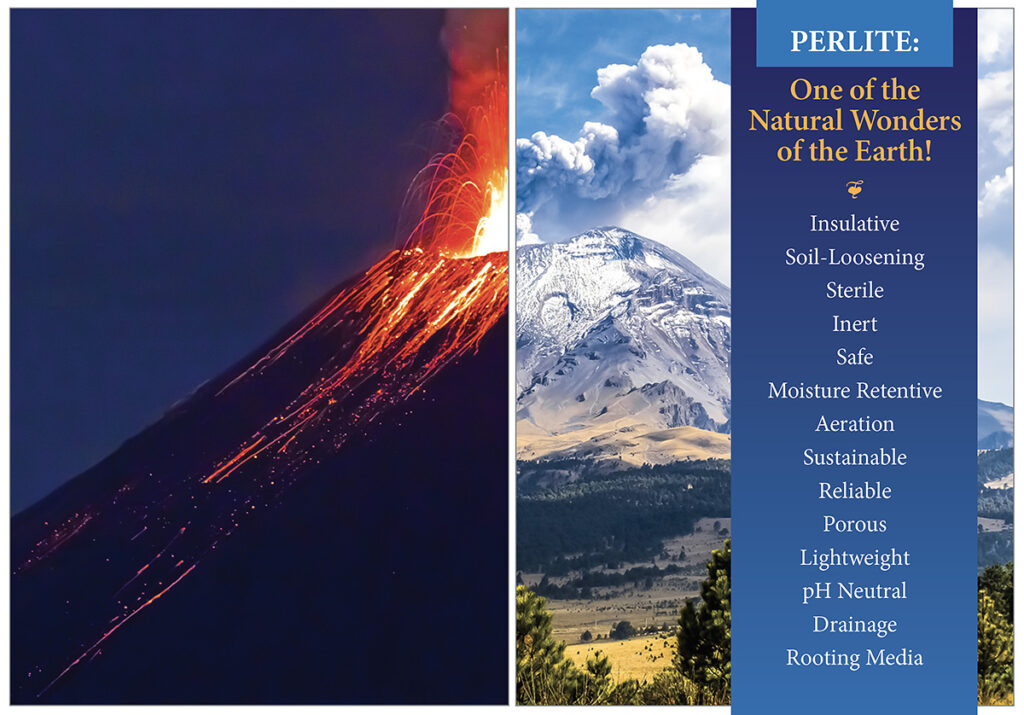
FORMATION PROCESS
The formation of perlite begins with volcanic activity, where lava cools quickly, trapping water vapor within its structure. As this lava solidifies into obsidian, it retains a significant amount of water. Over time, geological processes can lead to the secondary hydration of this obsidian from meteoric water, resulting in the formation of perlite. The key characteristic that distinguishes perlite from other volcanic rocks is its ability to expand significantly when subjected to high temperatures. It’s important to note that not all lava results in perlite. It is lava of aluminosilicate composition with minor but important sodium and potassium content (usually 2-4 wt. % each).
EXPANSION CHARACTERISTICS
When perlite is heated to temperatures between 871–1093 °C (1600–2000 °F)* exceeding its softening point, the water trapped within its structure vaporizes, creating tiny bubbles. This process causes the material to expand dramatically—up to 7–20 times its original volume—resulting in a lightweight, hollow, porous product. The expanded perlite appears white due to the reflectivity of the bubbles formed during this expansion process.
Uses Related to Its Volcanic Nature
Due to its unique properties derived from its volcanic origin, perlite is widely used across various industries. Perlite being safe, natural and abundant in nature makes it valuable and highly effective in many applications across various industries.
Horticulture: In horticulture, perlite serves as a soil amendment or hydroponic medium because it improves aeration and drainage while retaining some moisture.
Construction: In construction, expanded perlite is used in lightweight concrete mixtures, plasters, insulation materials, and ceiling tiles due to its low density and thermal insulating properties.
Filtration: Perlite’s porous nature makes it an excellent filtration aid in industries such as brewing and swimming pool maintenance.
Biotechnology: Perlite’s stability and non-toxicity allow for use in biotechnological applications, where it supports immobilization of biocatalysts.
Cosmetics: In cosmetics, perlite acts as an absorbent and mechanical exfoliant due to its fine texture after processing.
Conclusion
In summary, perlite originates from volcanic activity where obsidian undergoes hydration and subsequent heating leads to significant expansion. Safe, natural and sustainable make it valuable across multiple sectors including horticulture, construction, filtration systems, biotechnology, and cosmetics.

To download a .pdf of the Everything You Need to Know About the Origins of Perlite brochure, click here.
If you have technical questions on this topic, please email the technical contacts listed on our contact page.
Copyright © 2025 Perlite Institute All Rights Reserved